Lucy is an integrated data application platform for the American Express ecosystem, providing developers with data and application abstractions to simplify product development effort while satisfying complex enterprise requirements.
Data Application

Payment Authentication
Enable end-to-end secure scalable framework for eCommerce tokenization globally
Device + biometric enrollment

Purchase with passkey authentication

Key Impacts
Enablement increased by almost 100%
31% fraud reduction
Issuer enablement increased from ~40% to ~80% globally
10 Billion network tokens
10 Billion network tokens provisioned as of May 2024
Visa Token vs PAN-based CNP transactions
Overview
Role: Lead product designer
Scope: Drive the UX strategy to develop Visa's framework for device binding and biometric authentication
Timeline: Nov 2022 - March 2024
Responsibility:
-
Define and drove the design strategy, shaping the core flows for payment authentication
-
Framework development: design and delivered a comprehensive UX best practice Guide to streamline client onboarding and integration
-
Facilitate global, cross-departmental workshops to align regional stakeholders on unified product directions
-
Mentor designers through the creation of device binding with biometric authentication flow
Impact:
-
Enterprise Scaling & Go-To-Market (GTM): The authentication framework has integrated into other Major Visa Products.
-
Client Enablement: The UX Best Practice Guide streamlined alignment and integration with key fintech partners
-
Cross-Regional Alignment: Core UX flow and research insights accelerated consensus across regions, earning VP and SVP level recognition
-
Design influence: Established as a cross-functional case study that helped initiated broader design-led workshops
Challenges
E-commerce is Reshaping How We Address Fraud
Card-not-present fraud forecast to rise by 67% from 2019 to 2024. Meanwhile, there is an increase in mobile transactions.

In 2017, Visa has launch cloud token framework to brings additional benefits of device intelligence & consumer ID&V to e-commerce transactions

However, the adoption rate of Cloud Token Framework had been low since product launch.
Identify the Design Challenges
-
The product is super technical and partners have a hard time to understand the CTF flow
-
Top issuers are not meeting the mandate, which leads to low level of readiness for issuer enablement
-
Partner (Token requesters) are not implementing CTF at the desired rate due to the low enablement on the issuers' side.
-
The chicken and egg dilemma: Token requestors expected issuers to enable it first while issuer expected TR to do it first.
The Design Journey
Understand the Space
The Screen Appeared Simple, the Underlying Logic Was Far More Complex.
The project began as a request to redesign the existing interface. What initially seemed like a quick UI refresh soon revealed a deeper challenge: improving the visuals alone would not address the underlying problems or drive adoption.

Understand the Space
Mapped the End-to-End Transaction Lifecycle to Identify Key Partners and Critical Authentication Moments.
This was my second project at Visa, and I was still learning the complexities of the payment ecosystem. Mapping the transaction lifecycle helped me understand how the different partners, systems, and authentication steps connected behind the interface.

Drove Vision Through System Thinking
Applying System Thinking to the Payment Ecosystem
We enable our clients' success by enabling them to provide human-centric experience for their customers
How might we increase adoption rate for clients with design thinking?
Applying BJ Fogg behavior model to identify areas for improvements.


Drove Vision Through System Thinking
After the initial analysis, product stakeholders and I had multiple working sessions to map out core authentication journey and use cases. This helped us align on key design deliverables

(Snapshot of early user journey for device binding capability. Detailed diagram has been treated unreadable))
Design Strategy and Planning
Developing the Design Principles
The north star is to enable end-to-end secure scalable framework for eCommerce tokenization
Fraud Risk
Secure
Friction
Easy to use
Abimguous
Informative
Design Strategy and Planning
Identify Key Design Deliverables


Design Strategy and Planning
Developing Multi-Year Roadmap


Design Iterations and Testing
Step One: Introduce Cardholder Verification with Intent
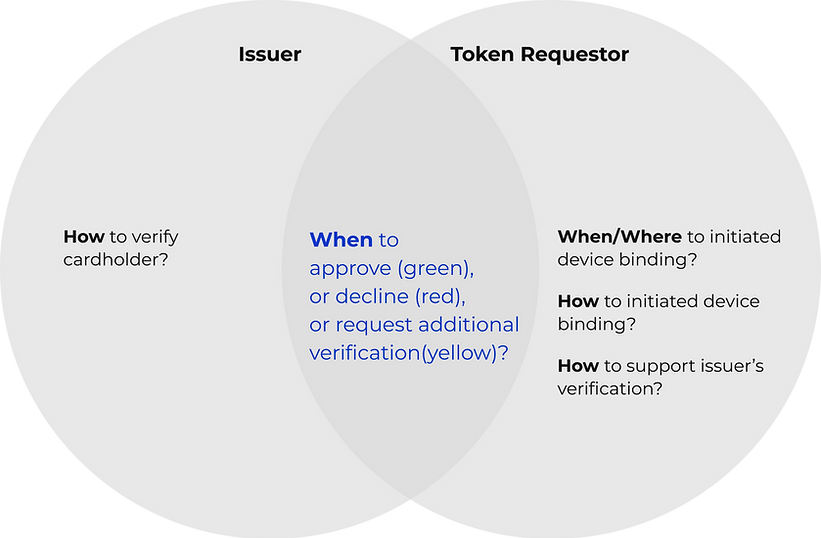
Meanwhile, I was mapping out detailed user journey flow and lo-fi wireframe. We also had many mini-workshops with stakeholders and developed the concept of "green/yellow/red flow" for device binding as well as the sample use cases for token requestor initiated cardholder verificaiton.

Through multiple rounds of journey mapping, I drastically simplified the diagram to focus exclusively on the Key Design Moment. There are two main capabilities of CTF: Device Binding and Token Requestor Initiated Cardholder Verification
For Device Binding, Key Moments are:
-
Device binding (link device with payment credential)
-
Pay with trusted devices

For Token Requestor Initiated Cardholder Verification, Key Moments are:
-
Cardholder verification when risky transaction detected

After the first round of redesign, we conducted a usability testing of the flow. One key finding we wanted to address is that participants see the value of device binding but not sure about the enrollment
What is the optimal moment in the e-commerce flow to engage consumers with device binding/enrollment?
Design iterations and testing
Step Two: Optimize Enrollment Channels
2.1 Encourage Token Requestors to Enable Multiple Touch Points for Device Binding
-
For new tokens, cardholder verification should be required after they add the card to merchant/wallet.
-
For existing token, we need to provide consumers the opportunities to link their device post-purchase and via account management to avoid impacting the checkout experience

2.2 Leveraging Regional Regulations
In regions unfamiliar with transaction verification, marketing should highlight the security benefits of Cloud Token Framework (CTF). Conversely, in regions where 3D Secure (3DS) is already standard, messaging should focus on friction reduction.
2.3 Incentify Partners
Cloud token framework enable a cloud token to be an authenticated payment credential. This helps token requestors to meet the requirement for liability shift.
Design iterations and testing
Step Three: Best Practice Guide for Partners


(Above are some selected pages from the best practice.)
Phase II: Developing New Capabilities
Device Intelligence + Biometric Authentication


Early Design Exploration of FIDO Authentication
We have explored CTF FIDO enrollment with various cardholder verification methods. In NA, the primary method we tested is OTP while bank app authentication was tested for EU.


A New Product Emerged from the Exploration:
Visa Payment Passkey
The FIDO Alliance, alongside Apple, Google, and Microsoft, officially announced an expanded commitment to build support for the common passwordless sign-in standard—widely known as a passkey—on May 5, 2022
Early 2024, Visa has started exploring the concept of Visa Payment Passkey. I also flew to London to help facilitate workshops with designers and stakeholders from different regions.


Enable and Scaling
As Visa Payment Passkey becoming one of the key authentication method we're focusing on, many other products like click to pay and visa installment starts to integrate with VPP.


May 2024, Visa has announced Visa Payment Passkey at VPF
-
2024 — Visa Payment Passkey launches at Visa Payments Forum, introducing biometric authentication for online payments.
-
2024 — Click to Pay integration begins, bringing passkey authentication into Visa’s checkout experience.
-
2024 — First market deployments launch with banking partners, including QNB in Qatar.
-
2025 — Global expansion accelerates across issuers, merchants, and payment service providers.
-
2025 — First PSP integration launches with noon payments.
-
2026 — Expansion into new markets, including Brazil, Guatemala, Ukraine, and India.
-
2026 — Payment Passkey becomes part of Visa’s broader authentication infrastructure, supporting the shift away from passwords and one-time codes.
Recognitions from Key Stakeholders
"Token Design and UXR team led by Chen, Yan, and Renita took on the challenge to reset the CTF work we've done till date and go back to discovery phase. They understood the product framework, and moving pieces, understood some of the leading hypothesis, put together flows and interview scripts. Not only did they do all this in a week, they also setup interviews in the holiday week on July 4th! Thankful for all this team brings to work everyday."
------ VP of Product
"I would like to thank Chen for the continuous support she provides for improving CTF. We greatly appreciate her efforts in educating us on design principles and helping us work with other design teams like content and research. Thank you for all your efforts"
------ Senior Product Manager on CTF